
What Top Brands Are Betting On Next
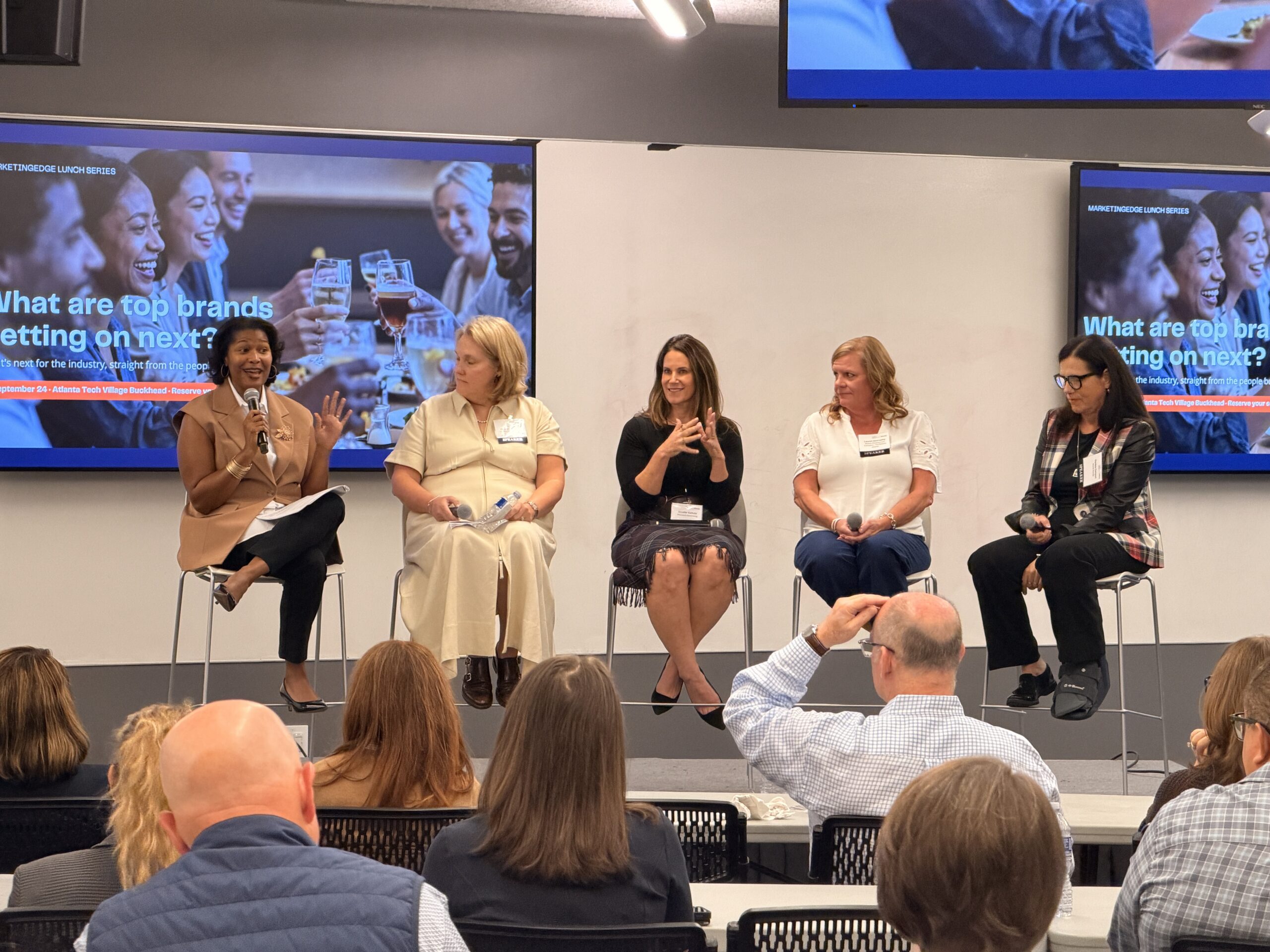
Takeaways from AMA Atlanta’s first MarketingEDGE Signature Luncheon
Atlanta marketers packed Atlanta Tech Village in Buckhead for the first AMA Atlanta MarketingEDGE Signature Luncheon. The panel skipped trend predictions and talked about where they’re putting budget, what they’re stopping, and how AI is changing how teams get built. Moderator Keisha Taylor Starr set the stage: AI has gone from “we should probably have a strategy for that” to “why isn’t this scaling faster?” Creators are turning into media companies. Media companies are turning into commerce platforms. And CMOs are still expected to do more with less, faster.
Meet the panel
- Jennifer Kattula, former General Manager and Chief Marketing Officer, Microsoft Advertising
- Lauren Abernethy, Vice President of Marketing, Braves Development Company / The Battery Atlanta
- Carol Dannelly O’Kelley, five-time CMO and Strategic Advisor, Verdant Growth Advisory
- Daniela Campari, Global Brand Director, Marketing for DYMO at Newell Brands, and marketing professor at Georgia State and Kennesaw State
- Moderator: Keisha Taylor Starr, former EVP, CMO and General Manager, Scripps Networks
The pressure behind every decision is growth
When Keisha asked the audience whether growth was their biggest pressure, most of the room raised a hand. Carol said every client conversation starts with growth. Her job is to help teams identify growth channels and figure out how to scale by improving efficiency, so revenue grows faster than costs. Jennifer said marketers are chasing growth through AI, and creators who can carry a brand message in a way that feels authentic and doesn’t read like advertising. Lauren described growth as more audience and events that bring the right traffic. Daniela used a lesson from the university classroom. In Porter’s Five Forces, customers and suppliers now have as much information as brands do, or more. The advantages marketers used to count on are going away. “We need to understand enough to be dangerous in every facet of the business,” she said.
The bets they are making
Bet 1: Real brand building is back
Daniela said the industry has had “a love affair with instant gratification” for 10 to 15 years. That habit is now a liability. When people, and AI systems, look up a brand, they don’t go to the website or the latest campaign. They go to Reddit, reviews and customer satisfaction signals. What they find is whether the brand has actually built relationships. At Newell, that means a return to real brand-building campaigns and less of what she called the transactional “feed me, feed me, feed me” cycle. Finance still wants ROI but she believes the brands that last will be the ones putting money back into the relationship.
Bet 2: New spaces for new audiences
The Battery Atlanta added a new LED screen at the Heritage intersection. That turned a space never meant for events into a second venue for game-day block parties. Those parties reach people who are sports-adjacent but not at the game. The bigger goal is scale. “If I have 30,000 people there for New Year’s Eve, how do I grow that event? I can’t grow it in that space,” Lauren said. “I need to add another space.”
Bet 3: Hire builders, not specialists
Jennifer has led AI transformation at Microsoft Advertising for the past 12 to 18 months alongside her CMO role. Her view is marketers have become so specialized that “we have forgotten the plot.” Ask her team how a campaign runs and you might get 50 different answers. Her bet is on systems thinkers who understand how the business makes money and are comfortable with technology. These are technical people who can build personal and team tools with AI, approved by engineering, so the team can test and learn much faster. “AI is not the answer,” she said. “It’s about getting to a better outcome.”
Bet 4: Know what AI is for before you scale it
Carol’s advice on AI starts with the question “what are we trying to achieve?” More productivity, lower costs, or more pipeline? Then get leadership to agree on the answer and the timeline. O’Kelley emphasized that teams need to agree with leadership on what AI should deliver. Is it lower costs, greater productivity, or more sales opportunities. Those goals can overlap, but success depends on a shared definition of the outcome and a realistic timeline for achieving it.
AI is a customer
Keisha framed the AI conversation as “AI is the brush, not the artist.” Jennifer then shared a stat she had heard the week before. According to Cloudflare data, more than half of web traffic now comes from AI agents, and she expects that share to keep climbing. For marketers, that means ChatGPT, Claude and the other agents are now a customer for the marketing mix. Her answer is to double down on brand and relationships. Brands need to check how they show up in AI interfaces, fix the tech and data behind that, and invest in answer engine optimization (AEO) and generative engine optimization (GEO). But she warned against overcorrecting. “We are marketing to people, and people still want to connect with humans,” she said.
The talent marketing needs now
Daniela raised an observation from the university classroom that fewer students are choosing marketing because they believe entry-level jobs have disappeared. If that continues, the best young talent will go to other fields. She said AI can now pull the data that junior marketers used to spend two years gathering. What teams need are people who can find the insight, spot the next opportunity and use data to predict what comes next. Keisha added the importance of being resourceful. Lauren wants to see ambition and a willingness to learn.
Your finance partner Is your secret weapon
Carol said boards want to know what marketing contributed to revenue. They don’t want lead counts. Her advice is to analyze which channels convert, turn off the ones that underperform and put more into the ones that work. “It’s okay to stop doing things,” she said. “One of the hardest things you’ll ever do is turn off a faucet, but sometimes you have to do it.” Daniela said AI makes that discipline easier. Channel tests that used to run four to eight weeks and cost hundreds of thousands of dollars can now show results much faster. She cautioned that channels feed each other, so attribution still takes careful thought. Jennifer said the team she has spent the most time with in the last two years is finance. Proving results to finance earns marketing room to experiment and invest in brand work that’s harder to measure. “If you’re not best friends with your finance partner, become best friends with your finance partner.” Carol summed it up: “Everyone talks about sales and marketing alignment. Marketing and CFO alignment is equally as important. It’s a secret weapon.”
The panel offered excellent tips for partnering with Finance:
- Educate, repeatedly. People need to hear something several times before it sticks. Walk finance through how specific tactics lead to specific results, including where returns start to drop off. (Jennifer)
- Learn their love language. Find out what matters to your finance partner, usually top line and bottom line, and bring them in early. (Daniela)
- Learn the vocabulary. There are plenty of free resources online. (Carol)
- Bring them into the work. Keisha once invited her CFO to an advertising sales event after he questioned its cost. Seeing the team build relationships with advertisers helped him understand the business value behind the investment.
- Include finance in agency selection. If they help pick the agency, you don’t have to sell them on it later. (Daniela)
- Cut your budget when asked, and don’t complain. It shows you understand the bigger business needs. (Carol)
- Admit what didn’t work. Trust is built by saying “that didn’t go as planned, so we’re adjusting.” (Keisha)
Experiences that bring people back
Keisha highlighted experiential marketing’s growing importance, and Lauren explained how The Battery Atlanta gives people reasons to return beyond baseball. A thoughtful mix of dining, shopping and entertainment, easy access, and a clean, safe environment create the foundation. Programming brings it to life, from yoga and girls’ nights to FIFA watch parties and dog-friendly events, giving different audiences a reason to visit. But a popular event still needs to make business sense.
Word of mouth, updated
People trust other people more than they trust advertising. Daniela explained that DYMO’s customers have very different needs, but whether they’re organizing a home or labeling electrical cables, they want to see how someone like them uses the product. For DYMO, that makes practical how-to videos from actual users more valuable than polished endorsements from high-profile influencers. Carol reinforced the point: “People care what other people say more than they care about what you say about yourself.” Keisha described influencer marketing as an extension of word of mouth, giving trusted recommendations to a broader audience. Jennifer also drew a distinction between automating creative production and developing original ideas. AI can help produce and test ads, but brands still need people to create distinctive work. Customers and creators contributing their own experiences, perspectives and ways of using a product, helps others see how it could fit into their lives.
Making time to think
Keisha closed the panel with the question “how do you protect time for strategy when everything moves faster?” Daniela emphasized being intentional about setting aside that time and communicating its importance to the team. Lauren schedules weekly strategy sessions with her direct reports, though she admitted some of her best ideas come while relaxing on the porch. Jennifer recommended choosing three to five priorities and keeping them at the center of team communications, meetings and reporting so urgent requests don’t derail the bigger goals. Carol advocated for calendar blocks, midweek no-meeting windows and well-run meetings, but her strongest advice was to step away from work. Time off and experiences outside the office can provide the perspective that sparks a new idea. As she put it, “The answer to your problems is not inside the building.”
So many Key Takeaways from this amazing panel
- AI is now a customer. Build a strategy for how your brand shows up to agents, not just to people.
- Brand building is a growth strategy. AI and buyers both look for real relationships, reviews and reputation.
- Hire builders and generalists. Systems thinkers with high agency will outperform narrow specialists.
- Decide what AI is for first. Productivity, cost or pipeline: get leadership aligned before you scale.
- Make finance your partner. Speak their language, include them early and earn room for brand work.
- Stop what isn’t working. Turning off underperforming channels frees money for what does.
- Hire people who speak up early. Look for team members who recognize potential problems and raise them before they become bigger issues.
Thank you to Jennifer Kattula, Lauren Abernethy, Carol Dannelly O’Kelley and Daniela Campari for sharing such candid perspectives, to Keisha Taylor Starr for keeping the conversation so sharp, and to Atlanta Tech Village for hosting. Most of all, thank you to everyone who took time out of a busy week to join us. As Daniela said, that time is an investment, and conversations like this are where the next good idea starts.
About MarketingEDGE signature luncheon series
The next MarketingEdge Signature Luncheon Series is on November 19, 2026 with Marketing’s New Mandate. Watch AMA Atlanta’s Events page and newsletter for details and registration.
About the author
Victoria Jones serves as VP of Programming for AMA Atlanta. She is a senior marketing executive currently CMO at Jan-Pro Systems International. She is a three-time entrepreneur with more than 25 years in brand and marketing leadership.